
The third post in this blog series discussing questions of attorney-client privilege raised in Prosecutor v. Bemba Gombo et al. (“Bemba”) will explore the contours of the attorney-client privilege used in international criminal tribunals. As discussed in my previous post, the attorney-client privilege is the oldest privilege for confidential communications firmly established in domestic legal systems. Its rationale is founded upon fundamental fair trial rights, primarily the freedom from self-incrimination and the right to communicate freely with Counsel. This privilege – which is not absolute – does not cover all communications between the lawyer and client. Continue reading “Attorney-Client Privilege – Part III: International Tribunals”
Category: ECCC

Hybrid Courts: a marriage of inconvenience
Last December I had the privilege of being invited to participate at a conference hosted by the International Research and Documentation Centre War Crimes Trials, in Marburg, Germany. The conference, titled The Defence in International Criminal Courts, was by far the best conference I have ever attended, focusing on defence issues from Nuremberg and onwards. The presentations and discussions were excellent. Here is an excerpt of my presentation. The full version is scheduled for publication.
Hybrid Courts: a marriage of inconvenience
Michael G. Karnavas
 Imagine being on the football pitch. The stakes are high – it’s a championship game. You and your teammates have been preparing for this game, sharpening your skills, studying your opponent, developing your game plan, mastering the intricacies of the rules, doing everything possible to take advantage of every opportunity that may present itself and every weakness that your opponent may have. All is riding on this game, so you have thought of everything. You are ready. You are ready to control the ball, control your opponent, control the slightest openings. Ready to control it all. All except the referee. That’s the wildcard. The unknown, the unpredictable, the uncontrollable. The luck of the draw. If the referee knows the rules and applies the rules as they are intended, then you have only yourself to blame if the game is lost. But what if the referee does not follow the rules or applies them unevenly, or interprets them in a manner that is not in keeping with the spirit and tradition of the game? What if the referee decides to also play with the ball, handle it a bit, kick it around, pass it to your opponents, or, worse yet, lay in wait near your goalpost for the opportune moment to tap the ball into your net (even if it takes using his hands) and, having done so, smugly signals the goal? Continue reading “Hybrid Courts: a marriage of inconvenience”
THE USE OF TORTURE-TAINTED EVIDENCE AT THE ECCC
THE USE OF TORTURE-TAINTED EVIDENCE AT THE ECCC: What is the applicable standard for assessing whether a statement is established as being made under torture and what are the parameters, if any, for the admissibility of torture tainted evidence?
The issue of the admissibility and permissible uses of evidence obtained through torture has arisen repeatedly at the Extraordinary Chambers in the Courts of Cambodia (ECCC) in Cases 001 and 002, due to the fact that there is a large body of material before the ECCC Court emanating from the notorious security center S-21 (also known as Tuol Sleng) and other alleged security centers around Cambodia.
Recently the issue has come up again, after the Trial Chamber prohibited the Nuon Chea Defence in Case 002/02 from questioning a witness on the contents of a confession. The Nuon Chea Defence asserted that the Trial Chamber was using a double standard, allowing the Prosecution to ask questions concerning confessions, but not the Defence. The Prosecution requested to file written submissions and to have oral arguments on the issue. The Trial Chamber agreed and the parties’ submissions were received 21 May 2015. Oral arguments occurred 25 May 2015. Continue reading “THE USE OF TORTURE-TAINTED EVIDENCE AT THE ECCC”
POPOVIĆ APPEAL CHAMBER REFUSES TO REVIEW JCE III APPLICABILITY
In my last post, I addressed the applicability of JCE III, arguing that as a product of judicial creation, JCE III does not exist in customary international law and should not be applied. This post is a follow up in light of the 30 January 2015 ICTY Appeals Chamber Judgement in the Srebrenica case, Prosecutor v. Popović et al., affirming the convictions for genocide.((Prosecutor v. Popović et al., IT-05-88-A, Judgement, 30 January 2015, paras. 1670-1674.))
One of the Popović Accused, Miletić, had argued that the Trial Chamber erred in law in holding that JCE III existed in customary international law at the time of the events.((Prosecutor v. Popović et al., IT-05-88-A, Judgement, 30 January 2015, para. 1670.)) He emphasized that the Extraordinary Chambers in the Courts of Cambodia’s (“ECCC”) rejection of JCE III shows that it is not generally accepted and that its application is contrary to the nullum crimen sine lege principle.
Unfortunately, the Popović Appeals Judgement missed an exquisite opportunity to rectify the long-perpetuated error of law first made by the Tadić Appeals Chamber, which found that JCE existed in customary international law. Rather than engage in a constructive analysis, the Popović Appeals Chamber merely referred to its previous jurisprudence and found that Miletić failed to demonstrate any cogent reason to depart from it.((Prosecutor v. Popović et al., IT-05-88-A, Judgement, 30 January 2015, para. 1674.)) This has been the problem from the outset. No ICTY Chamber has been willing to thoroughly analyze the state of customary international law; instead they choose to refer back to prior Judgements as if these Judgements themselves are evidence of JCE’s customary status. Continue reading “POPOVIĆ APPEAL CHAMBER REFUSES TO REVIEW JCE III APPLICABILITY”
The fiction of JCE III in customary international law
After countless challenges and criticism from a wide-range of legal traditions regarding the extended form of joint criminal enterprise (“JCE III”), the Pre-Trial Chamber of the Extraordinary Chambers in the Courts of Cambodia (“ECCC”) held that JCE III does not exist in customary international law.((Case of NUON Chea et al., 002/19-09-2007-ECCC/OCIJ (PTC38), Decision on the Appeals of the Co-Investigative Judges[’] on Joint Criminal Enterprise (JCE), 20 May 2010, para. 78.)) The ECCC Trial Chamber, in its Decision on the Applicability of JCE, examined additional case law relied upon for JCE III support, and upheld and affirmed the Pre-Trial Chamber’s conclusion.((Case of NUON Chea et al., 002/19-09-2007-ECCC-TC, Decision on the Applicability of Joint Criminal Enterprise, 12 September 2011, paras. 33-35.)) Continue reading “The fiction of JCE III in customary international law”
Karnavas critiques DeFalco article on “most responsible” at the ECCC
The ECCC has jurisdiction over “senior leaders of Democratic Kampuchea and those who were most responsible” for certain crimes within the ECCC’s jurisdiction.1 Randle DeFalco’s article Cases 003 and 004 at the Khmer Rouge Tribunal: The Definition of “Most Responsible” Individuals According to International Criminal Law, concludes that the suspects in Cases 003 and 004 fall within the meaning of “most responsible” and that the only legally sound option is to bring the cases to trial.
According to Michael G. Karnavas:
DeFalco’s analysis is result-determinative and based on the premise that if the suspects are not found “most responsible” there will be no other trials and the suspects would escape criminal responsibility. Although DeFalco’s basic approach to determine the meaning of “most responsible” is sensible, through his analysis he commits several errors that lead him to his pre-determined conclusion. DeFalco’s conclusions are unsurprising when considering his association with Documentation Center of Cambodia (“DC-Cam”) and interest in verifying its pre-determined conclusion that genocide and crimes against humanity occurred in Cambodia.
Click here to read Karnavas’ full critique of DeFalco’s arguments, which has been submitted to DC-CAM for publication.
- Agreement Between the United Nations and the Royal Government of Cambodia Concerning the Prosecution under Cambodian Law of Crimes Committed During the Period of Democratic Kampuchea, 6 June 2003, Preamble. [↩]
Associated Press quotes Karnavas on eve of Khmer Rouge verdict
 On the eve of the Khmer Rouge Tribunal Trial Chamber’s pronouncement of the judgement in Case 002/01 against KHIEU Samphan and NUON Chea, the Associated Press asked experts, including Michael Karnavas, to discuss the significance of the trial.
Read the story: With verdicts due, experts explain importance of trial of Cambodia’s Khmer Rouge leaders
Karnavas files ECCC Amicus on Geneva Conventions Statute of Limitations

On 14 May 2014 Michael G. Karnavas and Co-Lawyer ANG Udom filed an Amicus Curiae Brief urging that the ECCC is unable to exercise subject matter jurisdiction over grave breaches of the Geneva Conventions because those crimes are subject to a 10-year statute of limitation, which has expired for crimes committed from 1975-79. Read the brief here.
ADC-ICTY LECTURE ON CONFLICTS OF INTEREST
“‘Conflict of interests’ is a term that is often used and seldom defined.” 1
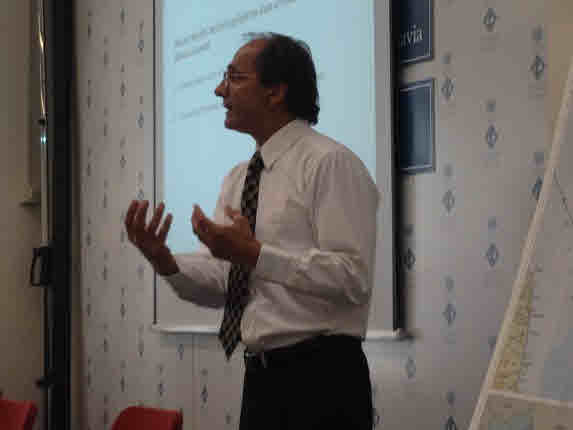
On 16 April 2014 I was invited by the Association of Defence Counsel practicing before the International Criminal Tribunal for the Former Yugoslavia (ADC-ICTY) to conduct training for its members and others on ethics. The topic chosen was Conflicts of Interest. The lecture lasted 2 hours. A modest PowerPoint presentation was used to guide the lecture which was based on handout material made available after the lecture. Certificates were also issued to the participants for those who wished to claim 2 hours of CLE on ethics with their national / state bar.
The lecture focused on the lawyer’s core responsibilities to the client in both national and international jurisdictions: competence, diligence, communication, confidentiality, loyalty, honesty, and independence. Principles that are universal.
Continue reading “ADC-ICTY LECTURE ON CONFLICTS OF INTEREST”
- Cuyler v. Sullivan, 446 U.S. 335, 356 (1980) (United States Supreme Court Justice Thurgood Marshall, dissenting). [↩]
The Co-Prosecutors’ attempt to eviscerate the principle of legalism at the ECCC … and beyond

On 4 March 2014 the ECCC Co-Prosecutors proposed amendments to ECCC Internal Rules 55 and 89ter to enable crime sites and criminal incidents to be excluded from the scope of investigation or trial upon their proposal. The proposed amendments, if recommended by the Rules and Procedure Committee and adopted by the Plenary, would introduce a procedure that is that is not founded in the Cambodian civil law system and which would not respect the principle of legalism that is unquestionably applicable before the courts of Cambodia, including the ECCC. Bluntly, the Co-Prosecutors are urging the Rules and Procedure Committee and the Plenary to engage in “situational ethics” to disregard the applicable law and legal system because it does not accommodate them. The Co-Prosecutors are urging the Judges to act ultra vires. Accordingly, I have submitted observations urging the Judges to reject the Co-Prosecutors’ proposed amendments in their entirety.
Essentially, under the principle of legalism, also called prosecutorial legalism, the prosecutor must prosecute when it is clear that a crime has been committed. The prosecution has no discretion as to whether to investigate crimes known to have been committed or to drop charges once an indictment has been secured. Judges have no discretion to abandon charges: whatever is in the indictment must be tried. Continue reading “The Co-Prosecutors’ attempt to eviscerate the principle of legalism at the ECCC … and beyond”