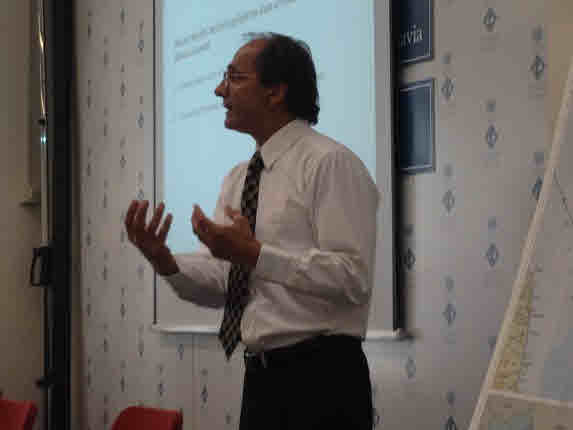
Last December I had the privilege of being invited to participate at a conference hosted by the International Research and Documentation Centre War Crimes Trials, in Marburg, Germany. The conference, titled The Defence in International Criminal Courts, was by far the best conference I have ever attended, focusing on defence issues from Nuremberg and onwards. The presentations and discussions were excellent. Here is an excerpt of my presentation. The full version is scheduled for publication.
Hybrid Courts: a marriage of inconvenience
Michael G. Karnavas
 Imagine being on the football pitch. The stakes are high – it’s a championship game. You and your teammates have been preparing for this game, sharpening your skills, studying your opponent, developing your game plan, mastering the intricacies of the rules, doing everything possible to take advantage of every opportunity that may present itself and every weakness that your opponent may have. All is riding on this game, so you have thought of everything. You are ready. You are ready to control the ball, control your opponent, control the slightest openings. Ready to control it all. All except the referee. That’s the wildcard. The unknown, the unpredictable, the uncontrollable. The luck of the draw. If the referee knows the rules and applies the rules as they are intended, then you have only yourself to blame if the game is lost. But what if the referee does not follow the rules or applies them unevenly, or interprets them in a manner that is not in keeping with the spirit and tradition of the game? What if the referee decides to also play with the ball, handle it a bit, kick it around, pass it to your opponents, or, worse yet, lay in wait near your goalpost for the opportune moment to tap the ball into your net (even if it takes using his hands) and, having done so, smugly signals the goal? Continue reading “Hybrid Courts: a marriage of inconvenience”