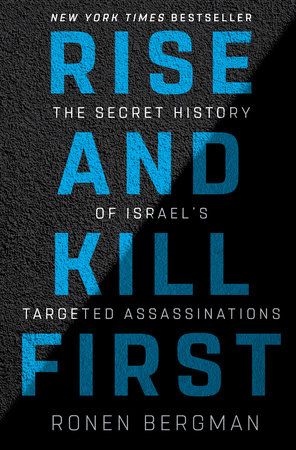
Book Review – RISE AND KILL FIRST: The Secret History of Israel’s Targeted Assassinations, by Ronen Bergman, Random House, 2018, $35.00, 725 pages.
Assassinations … have an effect on morale, as well as a practical effect. I don’t think there were many who could have replaced Napoleon, or a president like Roosevelt or a prime minister like Churchill. The personal aspect certainly plays a role. It’s true that anyone can be replaced, but there’s a difference between a replacement with guts and some lifeless character.
Meir Dagan, Chief of the Israeli Mossad (p. xix)
The distinguishing mark of a manifestly illegal order … is that above such an order should fly, like a black flag, a warning saying: ‘Prohibited!’ Not merely formally illegal, not covered up or partly covered … but an illegality that stabs the eye and infuriates the heart, if the eye is not blind and the heart is not obtuse or corrupt.
Judge Benjamin Halevy (p. 274)
 Targeted killings, assassinations, summary executions and reprisal killings; acts of assassination without parliamentary or public scrutiny; unrestrained killings and orders to down passenger airlines with innocent civilians; strikes against foreign diplomats; two separate legal systems – one for ordinary citizens and one for the intelligence community and defense establishment; bombings of hotels, buildings, and residences; preemptive strikes, kidnappings, and killings of political leaders; invoking “state security” to justify a large number of acts that could be subject to criminal prosecution and long prison sentences; massive amounts of unavoidable or unreasonable collateral deaths; deceptions, and lies to the Prime Ministers, including cover-ups and willful blindness by Prime Ministers themselves; killings of scientists, sympathizers, and poisonings; disregard for practice directives for state-sanctioned assassinations; manifestly unlawful orders and reprimanding those who refused to follow such orders; use of proxies to carry out assassinations, torture, and degrading interrogations; killings of unarmed prisoners, and much more.
-versus-
Indiscriminate attacks against innocent civilians; targeted killings; car bombings and using other explosives to cause maximum death of innocent civilians; suicide bombers and proxy fighters financed by antagonistic neighboring countries; acts causing maximum and sustained terror; provocations to draw military responses and loss of innocent civilian lives; rocketing of residential areas, use of civilians as human shields, building of nuclear reactors, and threats of annihilation; kidnappings of soldiers to torture and kill or to swap for hardened imprisoned militants whose aim upon release would be to continue their terrorist acts and killings, hijackings, car-bombings, senseless executions, deceptions, lies, broken promises, and blatant denials of knowing that some on their side committed atrocities while claiming to be pursing peace, and much more. Continue reading “Book Review – RISE AND KILL FIRST: The Secret History of Israel’s Targeted Assassinations”




 Two weeks ago the Office of the Prosecutor (OTP) of the International Criminal Court (ICC) filed a
  There seems to be sufficient evidence that Syrian government-backed forces used chemical weapons. It is not the first time, nor probably the last. Russia – whether it accepts it or not – bears responsibility for the use of what appears to be chlorine gas by the Bashar Al-Assad regime. No stranger to using chemical or biological weapons on its own nationals (albeit only sparingly and clandestinely, at