ADC and ICCBA: not a zero-sum game

Whenever you think you are facing a contradiction, check your premises. You will find that one of them is wrong.


Ayn Rand 

We must all hang together, or most assuredly we shall all hang separately.


Benjamin Franklin

Commenting on my most recent post “The ADC-ICTY Evolves into an Association of Defense Counsel Practicing before International Courts and Tribunals,” Chima Ayokunle wrote:

As far back as November 2013 you advocated on your blog that ICC ‘List Counsel must form their own Bar’ and ‘Only a Bar of List Counsel, by List Counsel and for List Counsel, can legitimately and passionately advocate for the needs of List Counsel’ (https://michaelgkarnavas.net/blog/2013/11/11/why-establish-a-bar-of-list-counsel-of-the-international-criminal-court/)

After this you were chair of committee drafting the Constitution for a Bar at the ICC and then you ran for president of the ICCBA and didn’t succeed.

It seems a contradiction to me that now you suggest that there could be more than one association at the ICC. Why be involved in establishing the ICCBA if this existing association could do it?

I wonder whether your view would be the same if you had been elected as ICCBA president?

Grateful to Mr. Chima Ayokunle for his musings.  My response: Continue reading “ADC and ICCBA: not a zero-sum game”

Share

The ADC-ICTY Evolves into an Association of Defense Counsel Practicing before International Courts and Tribunals

On 16 December 2016, the Association of Defence Counsel Practising before the International Criminal Tribunal for the former Yugoslavia, commonly referred to as the ADC-ICTY, held a second General Assembly Meeting.  The agenda had one item only: amending the ADC-ICTY Constitution to change the name of the ADC-ICTY to better reflect its function – effectively transforming it into an association for defense counsel practicing before international tribunals and courts. And so the ADC-ICTY Constitution was amended. Continue reading “The ADC-ICTY Evolves into an Association of Defense Counsel Practicing before International Courts and Tribunals”

Share

The ICC Registrar-Commissioned Reports Assessing the Legal Aid System: reasonable doubt at a reasonable price, realizing equality of arms, resource rationalization, and more

Ever since the International Criminal Court (ICC) was established, it has been rather unfashionable for defense counsel to praise the ICC Registrar for attempting, let along getting, something right for the Defense.  Why?

Much lip service is paid to the fair trial rights of the accused, the need for a robust defense for all accused, and, let’s not overlook, the attainment of equality of arms. While the ICC from its inception has extolled the virtues of the role played by defense counsel, it has, unabashedly, provided a pauper’s wage and meager resources.  Any prosecutor or judge would cringe were he or she in the dock dependent on a court-financed defense of the type funded by the ICC. Nothing new; with one or two exceptions, other international(ized) tribunals and courts are only marginally better.  The ICC, however, has taken it to the near extreme. Continue reading “The ICC Registrar-Commissioned Reports Assessing the Legal Aid System: reasonable doubt at a reasonable price, realizing equality of arms, resource rationalization, and more”

Share

Is the Myanmar government and military flirting with ‘acts of genocide’ against the Rohingya?

As a responsible Government, you don’t just go around hollering ‘genocide.’ You say that acts of genocide may have occurred and they need to be investigated.


David Rawson, United States Ambassador to Rwanda((As quoted in Douglas Jehl, Officials Told to Avoid Calling Rwanda Killings ‘Genocide’, NEW YORK TIMES, 10 June 1994.))

The Rohingya in Myanmar have by all accounts – save for those of the Myanmar government and military – been on the receiving end since at least 2012 of consistent, widespread, presumably organized, and arguably sanctioned acts of violence amounting to crimes against humanity. Take your pick of alleged crimes: persecution, rape, murder, forcible transfer, deportation, extermination, arbitrary detention and imprisonment, and arguably, apartheid.  The full treatment.

Ethnic cleansing with tinges of genocidal acts seems to be the obvious goal, or more ominously put, the desired solution: to expel and, if necessary, eradicate the Rohingya Muslims from the Rakhine state of Myanmar. Meanwhile, the international community and those most expected to speak loudly and repeatedly contently wait, naively or apathetically, for the criminal acts against the Rohingya to dissipate, for their plight to be resolved. Wishful thinking based in part on willful blindness. Continue reading “Is the Myanmar government and military flirting with ‘acts of genocide’ against the Rohingya?”

Share

Will the ICC Prosecutor be tempted by Israel’s settlement regulation bill?

On 5 December 2016, the Israeli Knesset approved a new draft of a bill recognizing West Bank settlement outposts – some 4,000 settler homes built on private Palestinian land. This measure has proved to be controversial, characterized by some as an illegal land grab. And by most accounts, it now appears that this measure was the tripwire for UN Resolution 2334 (2016), “reaffirm[ing] that the establishment by Israel of settlements … has no legal validity and constitutes a flagrant violation under international law and a major obstacle to the achievement of the two-State solution and a just, lasting and comprehensive peace.”(( United Nations Security Council Resolution 2334 (2016), S/RES/2334 (2016), 23 December 2016.)) Expectedly, acrimony and recrimination has followed.

One embarks on a discourse about Israel, Palestine, and the International Criminal Court (ICC) at his or her risk. Emotions run high on all sides. Comments made even with the best of intentions, and however measured, can draw fire, friendly and otherwise.  Difficult to have a friend-to-friend discourse without being labeled naïve, insensitive, pro-this or anti-that. Continue reading “Will the ICC Prosecutor be tempted by Israel’s settlement regulation bill?”

Share

Book Review – EAST WEST STREET: On the Origins of GENOCIDE and CRIMES AGAINST HUMANITY, by Philippe Sands

EAST WEST STREET: On the Origins of GENOCIDE and CRIMES AGAINST HUMANITY. By Philippe Sands. 437 pages. Weidenfeld & Nicolson, 2016. £13.99.

Frank: Tell me Rosenberg, was all this destruction and misery necessary? What was the sense in all that racial politics?


Rosenberg: I was only looking for a practical solution.((Alfred Rosenberg (Hitler’s foremost theorist on racial politics) claiming that mass murder and war was an unintended consequence of his racial politics, to Hans Frank (Governor-General of the occupied Polish territories, where four extermination camps – Belzec, Treblinka, Majdanek, and Sobibor – were located and under his overarching authority), as told by Baldur von Schirach, Gauleiter and Reichsstatthalter (Reich Governor) of Vienna, responsible for sending Jews from Vienna to German death camps. Philippe Sands, East West Street: On the Origins of Genocide and Crimes Against Humanity 283 Weidenfeld & Nicolson 2016, citing Gustav Gilbert, Nuremberg Diary 42 (New York: Ferrar, Straus, 1947). ))

Philippe Sands, QC

In the autumn of 2010, Philippe Sands was invited to deliver a lecture in Lviv, Ukraine, a city that in the past has also been called Lemberg, Lvov, and Lwow, depending on who controlled the territory.  The lecture centered on Hersch Lauterpacht and Rafael Lemkin, two legal giants whose theories on crimes of (state) sponsored mass atrocities and individual criminal responsibility featured prominently during the Nuremberg trial, irrevocably changing the legal landscape in international criminal law. Lauterpacht is credited with conceptualizing and introducing crimes against humanity into the Nuremberg trial. Lemkin is the conceptualizer and author of the crime of genocide; a crime that also featured at Nuremberg, albeit less prominently, but that would go on to be codified as an international legal instrument by the United Nations General Assembly when it adopted the Convention on the Prevention and Punishment of the Crime of Genocide on 9 December 1948.

But why Lviv?  Continue reading “Book Review – EAST WEST STREET: On the Origins of GENOCIDE and CRIMES AGAINST HUMANITY, by Philippe Sands”

Share

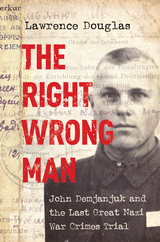
Book Review — The Right Wrong Man: John Demjanjuk and the Last Great Nazi War Crimes Trial, by Lawrence Douglas.

The desire to forget lengthens exile, and the mystery of salvation is called remembrance.

Inscription at Yad Vashem, Israel’s official memorial to the victims of the Holocaust

Lawrence Douglas’s The Right Wrong Man is an essential read for anyone involved in international criminal law.  It is an exceptionally well-written, well-researched, and well-reasoned treatment of the events, circumstances, challenges, and resolutions of bringing John Demjanjuk to account for being “the ultimate replaceable cog in an exterminatory machine…not because he committed wanton murder, but because he worked in a factory of death.  He was convicted of having been an accessory to murder for a simple and irresistible reason – because that had been his job.”(( Lawrence Douglas, The Right Wrong Man: John Demjanjuk and the Last Great Nazi War Crimes Trial 16 (Princeton University Press 2016). )) Continue reading “Book Review — The Right Wrong Man: John Demjanjuk and the Last Great Nazi War Crimes Trial, by Lawrence Douglas.”

Share

The ICC-OTP’s Report on Preliminary Examination Activities: Part III – Registered Vessels of Comoros, Greece, and Cambodia (the Mavi Marmara incident)

This is the third and final post in the series discussing the Office of the Prosecutor’s (OTP) Report on Preliminary Examination Activities (2016). In this series, I focus on three preliminary examinations (the situations in Afghanistan and Ukraine, and the situation on Registered Vessels of Comoros, Greece, and Cambodia, or the Mavi Marmara incident) and discussed the political considerations involved.

In the first post I briefly discussed the procedure for preliminary examinations established by the Rome Statute and the attendant modalities adopted by the OTP. Before an investigation can begin, the OTP analyzes whether the International Criminal Court (ICC) has jurisdiction over a situation, and whether the situation is admissible. The OTP examines whether a national court is already dealing with the situation, how genuine are the investigations/trial (complementarity criteria), and whether there is enough information on crimes of sufficient gravity (gravity criteria). Regardless of jurisdiction and admissibility, the OTP will finally consider whether there is a compelling reason not to take on this situation (interests of justice).

In the second post I discussed the situations in Afghanistan and Ukraine. My take is that regardless of whether the states fail to cooperate with and follow up on the OTP’s investigations, the ICC can affect some positive results by nudging (naming and shaming if necessary) certain states into prosecuting in domestic courts cases that fall within the ICC’s jurisdiction. To this end, the ICC can play a role of an investigative organ of the international community – serving fully investigated cases on a silver platter for states to prosecute.

In this final post I will discuss the Mavi Marmara incident. Continue reading “The ICC-OTP’s Report on Preliminary Examination Activities: Part III – Registered Vessels of Comoros, Greece, and Cambodia (the Mavi Marmara incident)”

Share

The ICC-OTP’s November 2016 Report on Preliminary Examination Activities: Part II – Situations in Afghanistan and Ukraine

In this post I will focus on the situations in Afghanistan and Ukraine. I will explore the pros and cons of investigations against non-signatory states that are also permanent members of the United Nations (UN) Security Council (P5 member states) and are unlikely to allow their nationals to be prosecuted at the International Criminal Court (ICC).

 Situation in Afghanistan

The situation in Afghanistan examines the alleged crimes committed during the armed conflict between the Afghan Government supported by the International Security Assistance Force (ISAF – first established by the UN Security Council, and later under NATO command) and the United States (US) forces on one side, and anti-Government forces (particularly the Taliban, and other groups) on the other side.(( ICC-OTP, Report on Preliminary Examination Activities, 14 November 2016, paras. 195-96 (hereinafter “ICC-OTP Report”). )) The conflict broke out in late 2001, triggered by the attacks of 9/11 (September 11, 2001). A US-led coalition launched air strikes and military operations against the Taliban in Afghanistan. After Osama bin Laden’s death in 2011, NATO gradually withdrew its forces. By 2014, the international forces supporting the Afghan Government ended their combat missions, but some forces remain for training, advisory, and assistance purposes.(( Id.)) Continue reading “The ICC-OTP’s November 2016 Report on Preliminary Examination Activities: Part II – Situations in Afghanistan and Ukraine”

Share

Sketches of the ECCC Supreme Court Chamber’s Judgement in Case 002/01

On 23 November 2016, the Supreme Court Chamber (SCC) of the Extraordinary Chambers in the Courts of Cambodia (ECCC) delivered the final judgement in Case 002/01, the first installment of Case 002 against the two remaining accused, Nuon Chea and Khieu Samphân.  Case 002 covers the events that occurred throughout Cambodia from 17 April 1975 to 6 January 1979 – from the fall of Phnom Penh to the Khmer Rouge to when it fell to the Vietnamese-backed Cambodian forces (effectively, disaffected Khmer Rouge cadre who had gone over to Vietnam).

The outcome was not surprising. Continue reading “Sketches of the ECCC Supreme Court Chamber’s Judgement in Case 002/01”

Share