Two weeks ago the Office of the Prosecutor (OTP) of the International Criminal Court (ICC) filed a request to the Pre-Trial Chamber (PTC) seeking, for all intents and purposes, an advisory opinion on whether the ICC may exercise jurisdiction over the alleged deportation of the Rohingya people from Myanmar to Bangladesh.
Recently there has been a sharp uptick in traffic to an October 2015 post I wrote on the crime-fraud exception to attorney-client privilege (reproduced below). This post was part of a four-part series on attorney client-privilege issues in domestic and international(ized) courts. I can only assume that the renewed interest in this subject is fueled by last week’s FBI execution of a search warrant on the office, home and hotel room of Michael Cohen, lawyer (some say “fixer”) for President Donald Trump. As I write, the issue is playing out in a United States District Court in New York, where Cohen, supported by Mr. Trump’s lawyers, is seeking an injunction to prevent the prosecutor from examining seized materials, based on attorney-client privilege.
Before this litigation is over we are likely to see a very high-profile addition to the canon of law on the crime-fraud exception to attorney-client privilege.
Attorney-Client Privilege — Part IV: The Crime-Fraud Exception
This post follows up on the discussion of the attorney-client privilege and the crime-fraud exception raised in Prosecutor v. Bemba et al. (“Bemba”) before the International Criminal Court (“ICC”). In my previous post, I presented an overview of the attorney-client privilege (otherwise known as “lawyer-client privilege” or “legal professional privilege”) in the international criminal tribunals. As previously discussed, one of the exceptions to the attorney-client privilege is the crime-fraud exception. This exception applies when communications are made in furtherance of a crime or fraud. In other words, the attorney-client privilege is not a shield to be used by either the attorney or the client to pursue or cover up criminal activity, including acts contributing to the obstruction or perversion of justice. The ICC Pre-Trial and Trial Chamber decisions in Bemba raise several questions concerning the scope of this exception. Before I get into those questions, let’s briefly review the history of the case. Continue reading “Attorney-Client Privilege — The Crime-Fraud Exception”
The Court and this trial were different. It was a Court for nearly all places and all times promising something most everyone in the world wanted badly, even if some state authorities remained wary. It was to bring tyrants to account, punish them according to their crimes, and give pause to others with tyrannical pretentions.
…
It was not just what kind of justice would be rendered for Lubanga. The Court itself was on trial.… Lubanga’s atrocities spoke for themselves, or so it appeared. They were well known in his country. They were well known abroad among the international organizations that had been forced to intervene to protect his victims, and they were well known among human rights organizations whose reporting brought his crimes to word attention. Something would have to go woefully askew for the trial to end up questioning the severity of the crimes. And yet, as the trial unfolded, the crimes became strangely and increasingly beside the point, buried under a spectacle of legal combat between counsellors who seemed more concerned with prevailing in the courtroom than worrying about what atrocities had been committed in Ituri and how to assign responsibility.
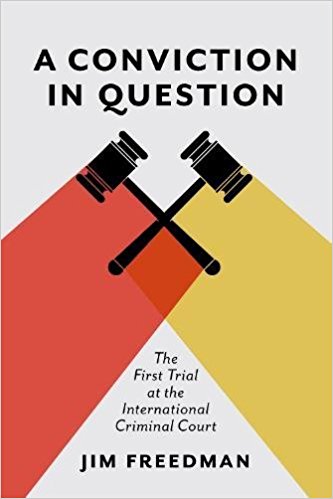
A Conviction In Question: The First Trial at the International Criminal Court, by Jim Freedman, University of Toronto Press, 2017, $32.95, 219 pages, pp. xiii, xvi-xvii
Uganda President Yoweri Museveni has turned hypocrisy into an art form. One moment he is railing against the International Criminal Court (ICC) for having the temerity to investigate, charge, and try individuals from the African continent alleged to have committed crimes falling under the ICC’s jurisdiction, and the next he is asking the ICC Prosecutor to charge anyone he deems out of favor, such as the recently sacked Uganda Inspector General of Police, General Kale Kayihura.
Uganda President Yoweri Museveni decorating General Kale Kayihura
Ok, maybe I am being simplistic. Museveni is not against the ICC exercising its jurisdiction in Africa (including Uganda) over some alleged criminals. He just does not think the ICC (or any court for that matter) should have jurisdiction over the likes of him – a sitting head of state. Why should he? The rule of law only applies to those not in power. Continue reading “The ICC: One Strongman’s tool is another Strongman’s annoyance”
He is sick and tired of being accused. … He wants to be in court to put the prosecutor on the stand.
Harry Roque, Philippines Presidential Spokesperson
Finally. On 8 February 2018, ICC Prosecutor Fatou Bensouda announced that the Office of the Prosecutor (OTP) would open a preliminary examination on the widely publicized allegations of extra-judicial killings ordered by President of the Philippines Rodrigo Duterte, committed as part of his war on drugs.
I once again repeat my call to Libya to take all necessary steps possible to immediately arrest and surrender Mr al-Werfalli to the ICC. I also repeat my call on all States, including members of the United Nations Security Council, to support Libya in facilitating Mr al-Werfalli’s arrest and surrender to the Court.
…
Only when perpetrators realise there will be serious consequences for their crimes can we hope to deter future crimes.
I am dismayed that Mr al-Werfalli appears to remain in a position of command, and allegedly continues to commit crimes with impunity, despite an official statement from the General Command of the Libyan National Army (“LNA”) in August 2017 that Mr al-Werfalli had been arrested and was under investigation by a military prosecutor. I once again call on General Khalifa Haftar, as commander of the LNA and superior of Mr al-Werfalli, to heed my previous call to the LNA to work with the Libyan authorities to enable the suspect’s immediate arrest and surrender to the ICC.
The appalling cycle of violence and impunity in Libya cannot be allowed to continue for the sake of the Libyan people and the security and stability of the country and the region.
The International Criminal Court (ICC) Prosecutor Fatou Bensouda was prompted to speak out and to once again solicit the assistance of the United Nations Security Council (UNSC) concerning the situation in Libya. This time it was about the two car-bombings on 23 January 2018 detonated by unidentified persons outside the Baya’at Al-Radwan mosque in Benghazi, Libya that killed more than 34 civilians, including children, and wounded over 90 others, and a video surfacing the following day apparently showing Major Mahmoud Mustafa Busayf Al-Werfalli executing 10 persons in front of the Baya’at Al-Radwan mosque, purportedly in retaliation for the two car-bombings.
To appreciate Bensouda’s call for assistance from the UNSC, we must reflect back to 2011 when Libya was engulfed in a civil war. On 26 February 2011, acting under Chapter VII of the UN Charter, and consistent with Article 13(b) the Rome Statute, the UNSC passed Resolution 1970, calling on the ICC to investigate the mass atrocities and human rights abuses which occurred (and continue to occur) in Libya during and after the overthrow of Muammar Gaddafi’s regime. In keeping with its obligations, the Office of the Prosecutor (OTP) has unhesitatingly abided – despite the lack of any appreciable assistance from the UNSC. Continue reading “THE LIBYAN REFERRAL: Trojan Horse or Realpolitik Casualty”
In 1788, Robert Burns, Scotland’s prodigious poet who is universally loved for his simple yet penetrating versus, penned the words to Auld Lang Syne – a song usually heard the world over on New Year’s Eve. Hard to find a Scot who does not know the words to and meaning of Auld Lang Syne (or the lines to most of Bobby Burns’ poems for that matter). But in case you have ever wondered, it basically means “a long time ago,” “days gone by,” or “for old times’ sake.”
In 1788 the Robert Burns sent the poem ‘Auld Lang Syne’ to the Scots Musical Museum, indicating that it was an ancient song but that he’d been the first to record it on paper.1
The poem/song is about looking back at old memories and friendships, reminding us to cling to these special moments and bonds as we are about to forge ahead into the New Year. But it is not so much about not letting go, as opposed to not forgetting – about cherishing past friendships and the past.
Caught in the moment of singing along (or trying like the devil to remember the lines we have mechanically mumbled through in previous years) as we celebrate the coming of the New Year and make our soon-to-be unkept resolutions, we tend to unconsciously ignore the biddings of Auld Lang Syne to reflect on the year passed. Imprudently, we habitually delude ourselves into thinking that looking in the rearview mirror is a superfluous indulgence that risks impeding our desire (and perhaps necessity) of letting go of the past for the sake of moving on.
With time waiting for no one, we have already started pressing into 2018. Unquestionably, 2018 promises to be an interesting year – if for no other reason than because of 2017. Hard to predict what is in store over the next 12 months, though much like examining a treasure map or a crossword puzzle, reflecting on some of the events over the past 12 months provide us with abundant clues. Not intending to present a summary of world affairs (such as The Economist, Time Magazine, and others do every December), I will merely refer to some of the events I have posted on, primarily limited to international criminal law (ICL) matters. And for anyone interested in what I have posted in 2017, here is a chronological list. You can also check the archives section of my blog. Continue reading “Reflections on 2017: past is prologue”
Confirms that … in the case of a state referral or proprio motu investigation the Court shall not exercise its jurisdiction regarding a crime of aggression when committed by a national or on the territory of a State Party that has not ratified or accepted these amendments.
Draft Resolution proposed by the Vice-Presidents of the Assembly Activation of the jurisdiction of the Court over the crime of aggression, ICC-ASP/16/L.10, 14 December 2017
On 14 December 2017, the Assembly of States Parties (ASP) activated by consensus the crime of aggression amendments adopted during the Kampala Review Conference in 2010. It had been agreed that the amendments would not be activated until at least 30 States Parties ratified the amendments and until the ASP decided to activate them.
The crime of aggression was already listed in the Rome Statute as the fourth crime when the States Parties signed on to it, but the International Criminal Court (ICC) would only exercise jurisdiction over this crime once a provision would be “adopted in accordance with articles 121 and 123 defining the crime and setting out the conditions under which the Court shall exercise jurisdiction with respect to this crime.” So, while the crime of aggression has been on the books, as it were, it was not defined, and the States Parties effectively provided themselves (their political leaders and military elite – the usual suspects in waging war) an escape clause. The adopted Draft Resolution is a manifestation of this escape clause. Continue reading “To opt-out or to opt-in, that is the crime of aggression “
On Friday 10 November 2017, The Fifth International Meetings of the Defence adopted the so-called Common Code of Professional Conduct for all Counsel appearing before the International Criminal Tribunals (Common Code). Aside from being a non-binding document (I hesitate to call it a code since it is nothing of the kind), it is flawed and hubristic. Indeed, it may be that everything you need to know about the arrogance of the document and its creators can be divined from the declaration that it is to be “referred to as the 2017 Nuremberg Code.”
The ADC – the first and without a doubt the most accomplished association of its kind – was not involved in the drafting of the Common Code. The ADC sent its members a copy of the “Proposed Code,” informing them that it received the draft relatively late in the process. After the ADC Executive Committee and Disciplinary Council made an initial assessment of the Proposed Code, and without circulating it to the ADC membership (for reasons that become obvious from the available correspondence and discussed below), it decided that the ADC could not sign the Proposed Code as presented. Continue reading “The Common Code of Professional Conduct: flawed and hubristic – Part I”
A State shall not be discharged, by reason of its withdrawal, from the obligations arising from this Statute while it was a Party to the Statute, including any financial obligations which may have accrued. Its withdrawal shall not affect any cooperation with the Court in connection with criminal investigations and proceedings in relation to which the withdrawing State had a duty to cooperate and which were commenced prior to the date on which the withdrawal became effective, nor shall it prejudice in any way the continued consideration of any matter which was already under consideration by the Court prior to the date on which the withdrawal became effective.
Rome Statute, Article 127(2)
It was coming for some time. On 27 October 2017, Burundi became the first State Party to withdraw from the International Criminal Court (ICC). The reasons for Burundi’s withdrawal are not important, though not a mystery. Motivated by a desire to shut down an investigation and to avoid the potential of having the powerful and elite charged and dragged to The Hague to be tried, Burundi bid farewell to ceding its jurisdiction to the ICC to investigate and prosecute crimes falling under the Rome Statute – whenever Burundi (as other States Parties) refused or was incapable of doing so. Continue reading “Burundi’s withdrawal from the ICC nixes ongoing OTP investigations: coming to grips with reality”

 Two weeks ago the Office of the Prosecutor (OTP) of the International Criminal Court (ICC) filed a request to the Pre-Trial Chamber (PTC) seeking, for all intents and purposes, an advisory opinion on whether the ICC may exercise jurisdiction over the alleged deportation of the Rohingya people from Myanmar to Bangladesh.